


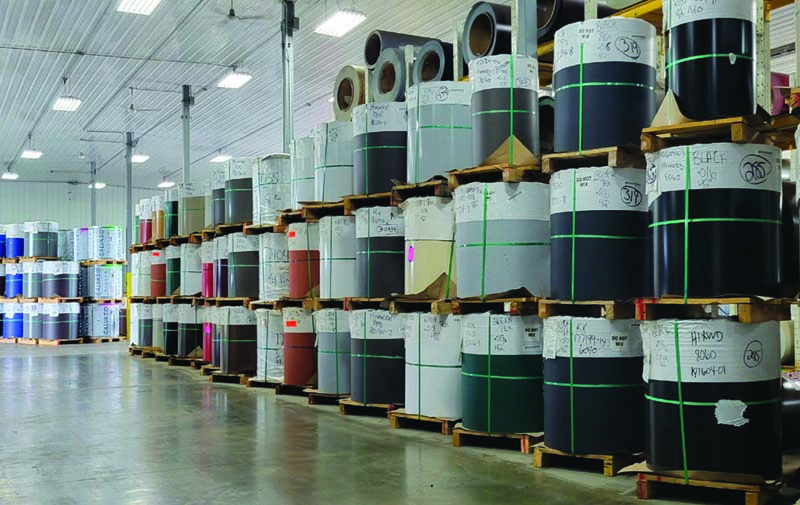
Originally Published as: Inventory Strategy in a Volatile Coil Market: Balancing Service, Risk, and Working Capital in Coil Supply
For coil suppliers and roll formers alike, inventory strategy is never just about how much steel sits on the floor. It is a constant balancing act between service, risk exposure, and margin performance. The goal sounds simple: meet customer demand within required lead times. In practice, it requires disciplined forecasting, sourcing redundancy, operational flexibility, and a clear understanding of where value is created.
Across the supply chain, companies are approaching that balance differently — some emphasizing inventory turns and working capital discipline, others building their value proposition around high on-hand availability. Each model carries its own risks and advantages.

Balancing Service, Risk, and Margin
On the supplier side, inventory management often begins with a three-part objective: meet customer lead times, limit exposure to price volatility, and avoid excessive working capital tied up in slow-moving stock.
To maintain flexibility, many suppliers delay production steps until they are operationally necessary. Production deferral reduces pricing risk and allows companies to respond to shifts in demand. Coil sizing and production processes are optimized to reduce scrap and improve yield, protecting margins that can otherwise be eroded by hidden costs.
For products requiring significant stocking positions, inventory health is managed actively. That means tracking turns and velocity, conducting routine portfolio reviews, and adjusting SKUs based on movement. If a product cannot turn four times per year, some consider it an inefficient use of capital. Some view a three-month supply as the best-practice financial benchmark.
Color trends complicate that discipline. If a color falls out of favor and inventory lingers, capital becomes trapped. Backing off slow-moving colors becomes necessary, even when the instinct is to offer broader variety.
If a customer wants a color or style that is not on hand, Hixwood will custom make it for them. It will take some extra time, but it is likely that all suppliers have found it to be a low performer, and the customer is likely going to have to wait anywhere they go.
On the other hand, running too lean does carry a risk: lost sales.
High Inventory as a Core Value Proposition
Some suppliers have built their strategy around the opposite approach — carrying significant coil inventory so customers do not have to wait.
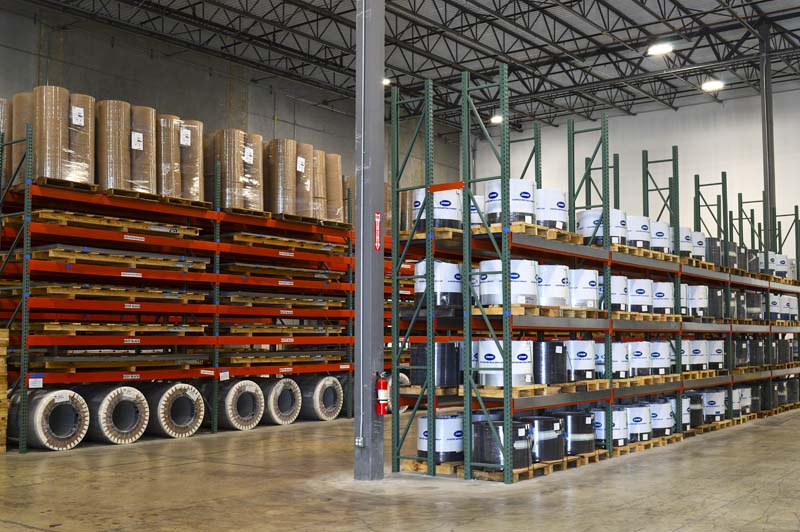
For these companies, such as Coated Metals Group, inventory on the ground is the value. Large facilities, racking systems, trained fulfillment staff, and organized storage allow them to maintain broad SKU counts across gauges, widths, and colors. Common master coil widths such as 40, 42, and 48 inches are stocked alongside multiple gauges — often 22 through 28 gauge in primary colors, earth tones, and darker architectural shades. Prefinished 4’ x 10’ sheets and coil in standard 16-, 20-, and 24-inch sizes are readily available, and even uncommon sizes can be accommodated when demand justifies it.
This approach requires capital and infrastructure. Cash flow is tied up in stock. Storage space must be sufficient. Order fulfillment accuracy becomes critical, but proponents argue that high inventory mitigates more risk than it creates.
During supply chain disruptions, including the COVID period, companies operating lean models often faced price volatility and long mill lead times. Those carrying deeper inventory were able to stabilize supply for customers. Some even expanded SKU counts when master coil widths were delayed, introducing alternative sizes to keep projects moving.
From that perspective, stability becomes a competitive differentiator. Contractors do not lose jobs because material is unavailable; they can schedule confidently, protect margins, and add to the bottom line.
Forecasting, Contracts, and Domestic Sourcing
Inventory discipline begins upstream at the mill.
Many roll formers contract inbound steel in consistent monthly volumes, often ordering large quantities — sometimes approaching a million pounds at a time — divided across core colors. Coil weights are set strategically, for example ordering 8,000- to 8,500-pound coils within mill tolerances of plus or minus 15 percent.
Forecasting drives those allocations. Some companies encourage customers to share projections but recognize that forecasts shift. Rather than relying heavily on customer commitments, they monitor order patterns. If a color begins trending upward over several weeks, they increase orders to ensure availability.
Most coil programs revolve around a core group of painted products — perhaps 100 high-movement SKUs. These are the items expected to turn at least four times per year. If a product becomes a slow mover internally, it is often slow market-wide. In those cases, customers will likely face wait times regardless of supplier.
Domestic sourcing has become a stabilizing factor for many operations. All-domestic supply chains allow closer alignment with both micro and macroeconomic conditions and reduce disruption risk. Long-term relationships with mills, paint vendors, and customers reinforce that stability.
Cost Drivers Beyond Coil Price
Material cost increases have reinforced the need for production deferral, working capital discipline, and diversified sourcing.
But coil cost is only one component of the inventory equation. Scrap represents a hidden expense, which is why Englert optimizes coil sizing and production processes to reduce scrap and improve yield. Freight, particularly inbound, must be managed carefully, even when outbound freight is minimal or absorbed. Warehousing contracts may require 90-day commitments or renegotiation windows. Some companies outsource storage when it makes economic sense, particularly in regions where geography limits distribution reach.
Inventory that does not move ties up cash that could be invested elsewhere — new profiles, additional equipment, facility expansion, or geographic growth.
JIT vs. Availability: The Ongoing Debate
Just-in-time models reduce inventory carrying costs but increase exposure to mill lead times and price swings. High-availability models increase carrying costs but protect service levels.
The right answer depends on market position.
If a roll former loses a job because a competitor has matte black on the floor and they do not, the cost of that lost sale outweighs carrying expense. During periods of heavy demand for low-gloss and matte finishes, suppliers with ready stock gained market share, while JIT manufacturers fielded calls explaining why material was unavailable.
Conversely, excessive inventory in declining colors or finishes erodes financial performance. Englert believes that material cost increases will support continued emphasis on production deferral, working capital discipline, and diversification of supply sources to provide flexibility and manage cost.
Many companies attempt to resolve the dilemma with hybrid strategies: disciplined core inventory, selective expansion into high-demand specialty finishes, and diversified sourcing to manage disruption risk.
Market-Driven SKU Expansion
Inventory strategy is increasingly market-driven. According to Coated Metals Group geographic expansion often requires adding new master coil widths to match regional preferences. For example, a Texas market might demand 21-inch coil, prompting introduction of 42-inch master coil to support it.
Color trends are monitored through multiple channels — customer conversations, architectural and interior design influence, trade publications, paint vendor partnerships, and broader aesthetic shifts. The growth of matte and ultra-low-gloss finishes reflects both visual preference and functional benefits, such as reducing perceived oil canning.
Some suppliers are expanding into printed wood-grain and natural-material mimicry products. As paint technology advances, SKU counts will likely continue increasing.
Managing Inventory Health
Regardless of strategy, inventory health must be actively managed.
Key metrics include:
• Turns per year
• Velocity by SKU
• Working capital exposure
• Scrap rate and yield optimization
• Service level performance
Routine portfolio reviews help ensure that capital is allocated to products that move. Slow movers are evaluated and reduced. Core items are protected.
Companies like Hixwood ensure that loyal customers receive allocation priority during tight supply conditions. Clear communication about mill lead times and realistic delivery expectations help manage downstream planning.
Looking Ahead: Data and AI Integration
Data management and AI-driven forecasting are expected to play a larger role in coil inventory strategy in the years ahead. Enhanced demand pattern recognition, improved SKU rationalization, and predictive ordering models could reduce both stockouts and excess inventory.
At the same time, geography, paint technology innovation, and customer responsiveness will continue to shape inventory models.
In the metal industry, reliable partnerships remain central. Contractors should not have to worry whether their supplier has material available. The ability to schedule confidently, avoid delays, and secure material when competitors cannot may ultimately matter more than incremental carrying costs.
Material cost increases will support continued emphasis on production deferral, working capital discipline, and diversification of supply sources to provide flexibility and manage cost.
Inventory strategy, then, is not simply about how much steel is on the floor. It is about aligning service reliability, financial discipline, and market responsiveness — and knowing where your competitive advantage truly lies.
Resources
• Coated Metals Group – www.cmgmetals.com
• Englert, Inc. — www.englertinc.com
• Hixwood — www.hixwood.com