


One of the challenges your customers face when building with metal is the risk of future corrosion—even if the primary material is wood and it’s fastened with metal. Without fasteners that resist environmental elements, the structure may eventually collapse, likely due to corrosion.
What Is Corrosion?
As anyone who works with metal knows, metal left exposed to the elements is prone to corrosion. Metal components can become rusty or appear as though they have a disease breaking them down. That’s because they are deteriorating.
Corrosion occurs at the atomic level. Electrochemical corrosion happens when metal atoms lose electrons—a process called oxidation—to oxygen, water, or other compounds. Subsequently, the metal reacts with environmental substances like air, water, or acids. For example, in the formation of iron rust, water, oxygen, and iron atoms interact, forming rust or iron oxide.
When oxidation occurs between different types of metals in contact, the interaction causes galvanic corrosion. Galvanic corrosion involves the transfer of electrons between metals, meaning one metal gains electrons (the cathode) while the other metal (the anode) loses electrons. The cathode gains some protection and corrodes more slowly than it would alone, but the anode corrodes more quickly. An electrolyte must be present for galvanic action to occur. A common example is a stainless-steel window frame fastened with carbon steel screws; the screws will likely corrode at an accelerated rate.
While corrosion is generally harmful to structures, it can sometimes be harmless or even protective. An example is the greenish patina that forms on copper; this corrosion actually protects the underlying metal. However, this protective “film” can be scratched, leading to corrosion in the unprotected areas.
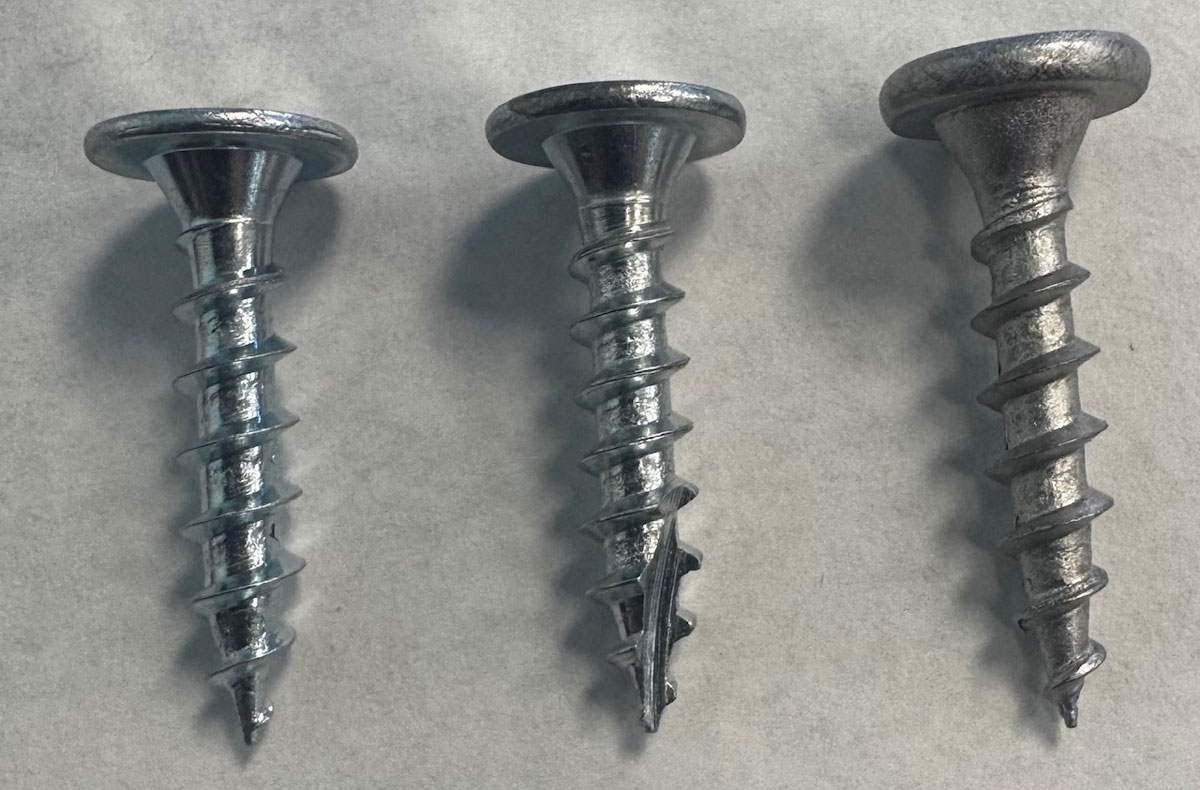
Electro-plated galvanized next to upgraded 1000-hour DMG85 Ceramic Coating.
Photo courtesy of Direct Metals, Inc.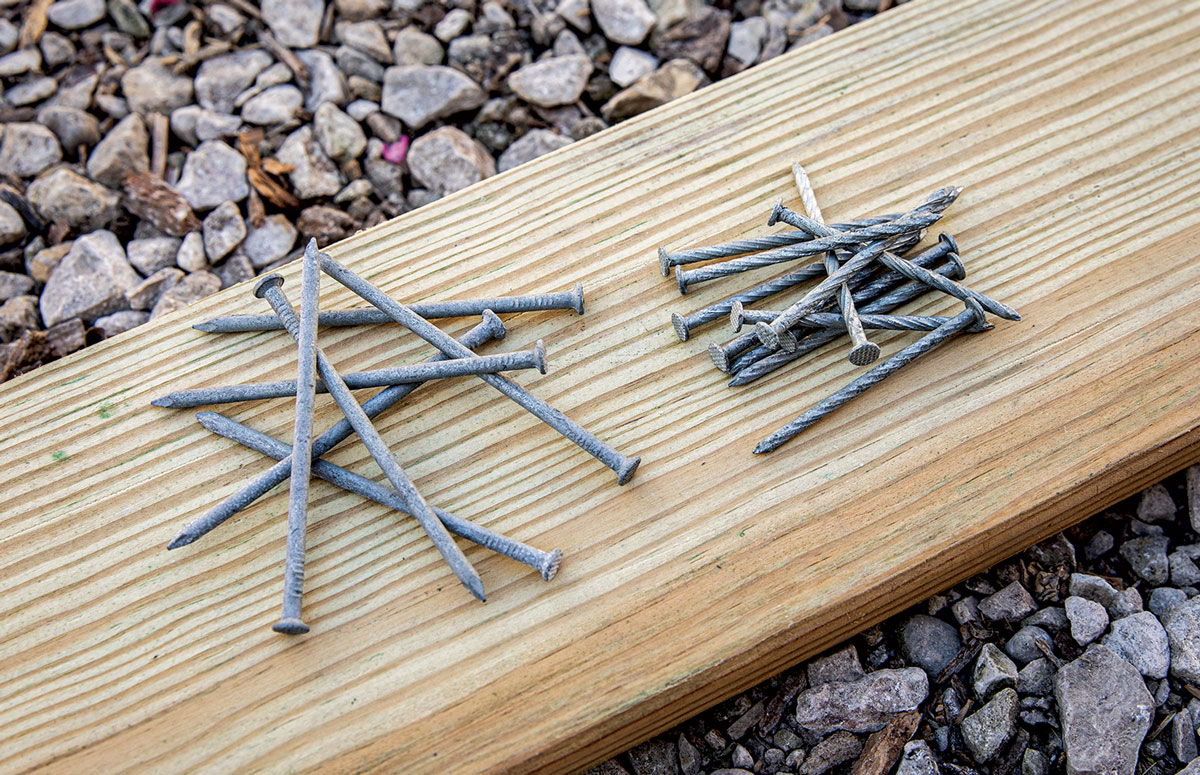
PTL (pressure treated lumber) nails are the type of galvanized nails recommended by wood treaters. Photo courtesy of Maze Nails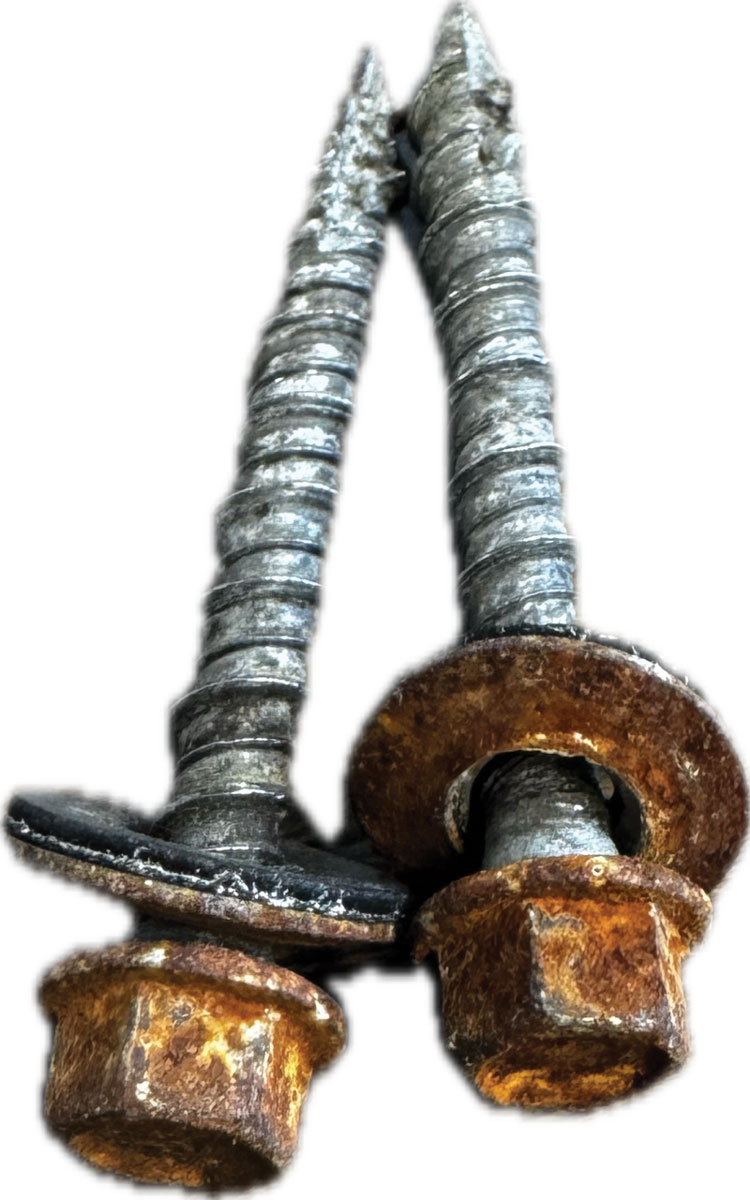
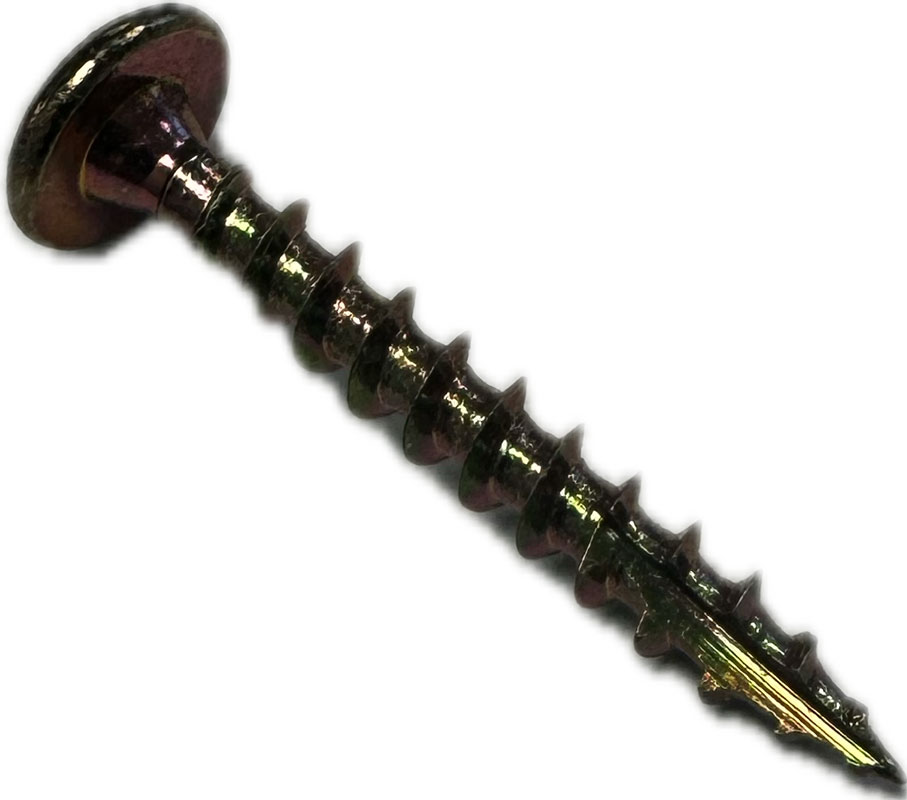
Zinc plated fasteners with a 1000-hour organic coating installed in a salt spray environment. Capped fasteners such as the Direct Metals, Inc. SCAMP stainless cap head fastener help resist this corrosion Photo courtesy of Direct Metals, Inc.
Protective Finishes
Various finishes are available to preserve and protect fasteners from weather. We’ll review some of the most common types to help you determine which coating will best curtail corrosion.
White and Yellow Zinc Electroplating
Electroplating involves immersing fasteners into an electrolytic solution and passing a direct current through it. The current ionizes the zinc solution, depositing a pure zinc coating on the metal. Unlike iron oxide, zinc oxide does not break down the metal surface; instead, the zinc layer is protective. It sacrifices itself by corroding so that the underlying metal doesn’t.
Average salt spray testing numbers, based on ASTM B117 standards, show 125 to 225 hours of corrosion-free performance, depending on the zinc thickness. This protection can be effective in applications where salt exposure is minimal and can be more cost-effective than other options. However, hydrogen embrittlement—the movement of hydrogen atoms into the metal, making it brittle and possibly leading to cracking—is a potential issue with this coating.
Zinc electroplating is not suitable for use with ACQ lumber (due to the copper treatment) or for fasteners that will contact copper or aluminum.
This finish is more affordable than many others and is sometimes used as an underplating for another coating. For example, DMG85 is a three-layer surface treatment finished with a ceramic coating that encases the zinc layers, preventing them from sacrificing electrons and corroding. Direct Metals Inc. applies this process to their carbon steel and
304 stainless steel fasteners. Salt spray testing has given these fasteners a 1,000-hour salt spray rating.
Mechanical Zinc Plating
(Also Known as Galvanizing)
Galvanizing is accomplished by cleaning the fasteners, applying a protective base coat, then adding multiple zinc layers, usually through drum tumbling with zinc and other chemicals. The fasteners are then baked in an oven to remove moisture. The zinc layers end up thicker than those from electroplating, though they may not be as uniform. This process does not emit hydrogen; therefore, it does not lead to hydrogen embrittlement. Salt spray corrosion testing ranges from 200 to 500 hours, depending on coating thickness. Galvanized metal can last a long time in environments without salt spray.
Hot-Dip Galvanizing
The hot-dip process is straightforward. First, the fasteners are cleaned to remove contaminants and any ionization. Then, they are completely immersed in molten zinc, leaving a strong inner coating of zinc-steel alloy and an outer layer of pure zinc. The quality of the bond is determined by how clean the metal was when dipped. Many industry professionals believe that hot-dipping is the best way to achieve a thick, even zinc layer.
Fasteners can also be double-dipped to ensure any slight imperfections in the first coating are filled in. Maze Nails’ STORMGUARD® Nails are an example of this process and have proven their durability over 85 years in the field.
Variations on Hot-Dip Galvanizing
One variation of the traditional hot-dip method is ET&F® (a BECK brand) Aericote® 1000. This patented, zinc-rich coating is created by immersion using the dip-spin method, similar to painting. It is free of hydrogen embrittlement, and if abraded, a zinc oxide-carbonate mixture protects it, performing a“healing” function. It is rated for 1,000 salt spray hours corrosion-free.
Zinc Flake
Like the previous options, this coating results in a protective zinc layer. It is created through the inorganic bonding of zinc and aluminum flakes, usually by dip-spin, rack dip-spin, or spraying. Though zinc flake coatings are thinner than some options, they offer excellent corrosion resistance, with salt spray corrosion testing of 1,500 hours or more.
Dacro Coating
This inorganic zinc/aluminum coating provides a uniform coat; a double-dipped coating is only about 4–8 microns thick. It does not bond with the surface, resulting in a lower level of corrosion resistance compared to some options. It generally compares to galvanization but prevents hydrogen embrittlement. It performs well at high temperatures.
Phosphate Coatings
Phosphate coatings are typically not used for items exposed to weather but make an excellent base layer that helps a second layer adhere to the fastener. They also contribute to corrosion resistance and durability.
Nickel Plating
Nickel plating is considered attractive and corrosion-resistant. It can withstand several hundred hours in the salt spray test, and a zinc-nickel coating is rated for up to 720 hours.
Spin-Dip Water-Based Paint
This option was designed to provide corrosion resistance while allowing a color match to the metal panels it fastens. Although vulnerable to UV exposure over time, it still offers strong paint fade protection and corrosion-free performance in the salt spray test beyond 1,000 hours.
Polymer Coatings
Powder is applied to the fasteners, often sprayed on, then a current is applied. It is baked on to fuse the particles, creating a complete layer. This results in a hard and chip-resistant coating. Polymer powder coatings tend to be more corrosion-resistant and durable than zinc electroplating but less corrosion-resistant than galvanizing. However, some organic polymer coatings, such as Dynamic Fastener’s Dyna-Coat, provide over 1,000 hours of protection against corrosion in the salt spray test.
Choosing the Right Coating
While we haven’t covered all possible coating options, we’ve examined many common ones. Hopefully, you now have a better idea of which fastener coating to recommend to your customers based on the elements and materials the fasteners will encounter. By considering the customers’ needs and budget, the appropriate options will become apparent. As one industry professional said, “You pick based on suitability and availability.”
Rollforming Magazine extends its thanks to the following contributors:
Beck America • www.beck-fastening.com
Direct Metals, Inc. • www.directmetalsinc.com
Dynamic Fastener • www.dynamicfastener.com
Maze Nails • www.mazenails.com
Triangle Fastener Corp. • www.trianglefastener.com