


Originally Published as: Accessories Keep a Shop Rolling: Considerations in Choosing Tables, Racking, and Conveyors
In a rollforming operation, productivity isn’t limited solely by the forming machine. It can be constrained by how efficiently material is staged, handled, and moved before and after forming. Tables, racks, carts, and conveyors all play a role in keeping lines running, protecting finished product, and making better use of shop space—especially as shops add more colors, profiles, and quantities.
While there’s no single “right” way to set up a shop, experienced rollformers tend to focus on one core goal: keeping the machines running as much as possible. Accessories that reduce handling time, simplify changeovers, and prevent bottlenecks can increase output without the expense of adding another machine.
Tables
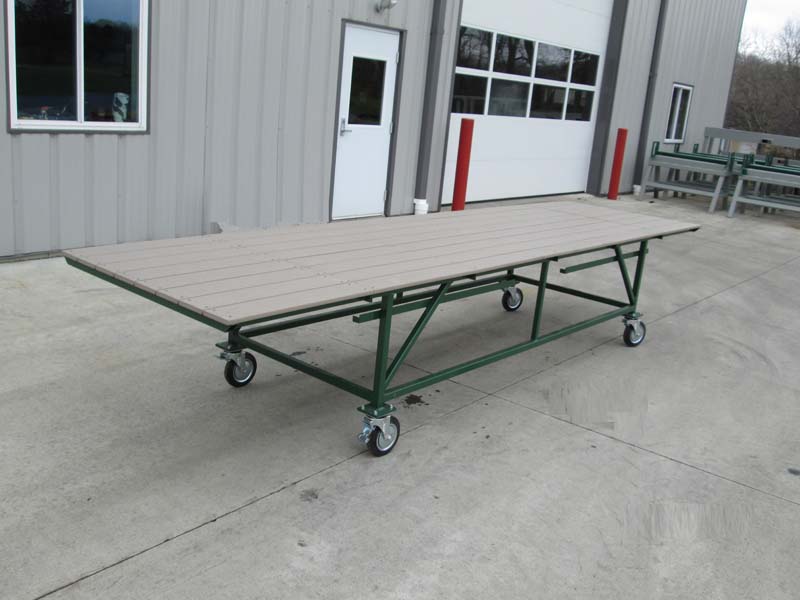
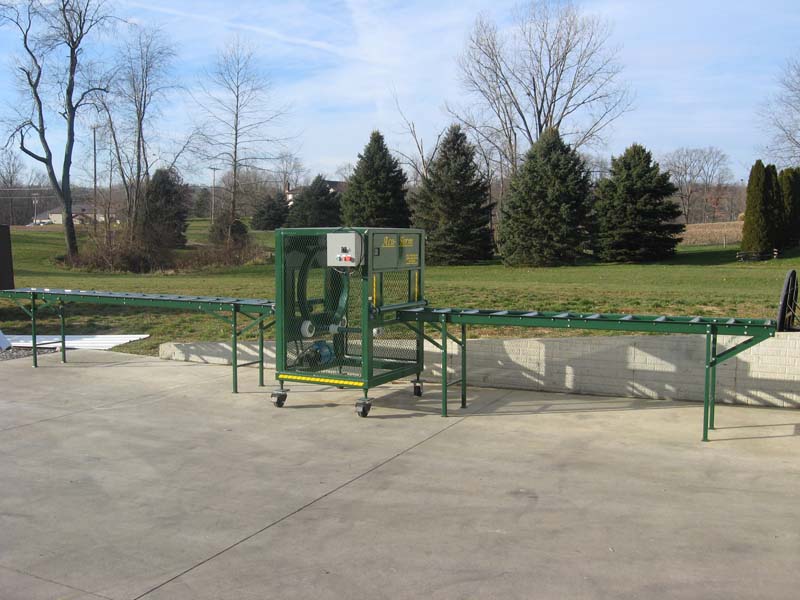
Tables are often the first accessory added to a roll-forming line, and roller tables are the most common. Designed to receive panels directly from the roll former, rollers allow long panels to move smoothly without dragging, preventing surface damage and minimizing manual handling.
Table height is critical. Many shops size tables to match downstream equipment such as folders or trim roll formers. Others request adjustable-height tables, particularly when running roll formers that produce multiple profiles at different exit heights. In those cases, electric-over-hydraulic tables can allow operators to raise or lower the table with the flip of a switch, keeping production moving when switching profiles.
Length is another key factor. Common table sizes are designed for 10-, 13-, or 21-foot panels, but some operations run much longer setups, including conveyor-style tables exceeding 40 feet. When tables are placed end to end, leaving gaps for emergency access is a common safety practice. Up to two-foot gaps can usually accommodate the panels without causing warping or oil canning.
Wheeled tables remain popular, especially in smaller shops or where layouts change frequently. However, carts or rack-based systems with multiple shelves are another useful option, sometimes offering more storage capacity while still allowing finished material to be moved easily.
Power Tables and Conveyors
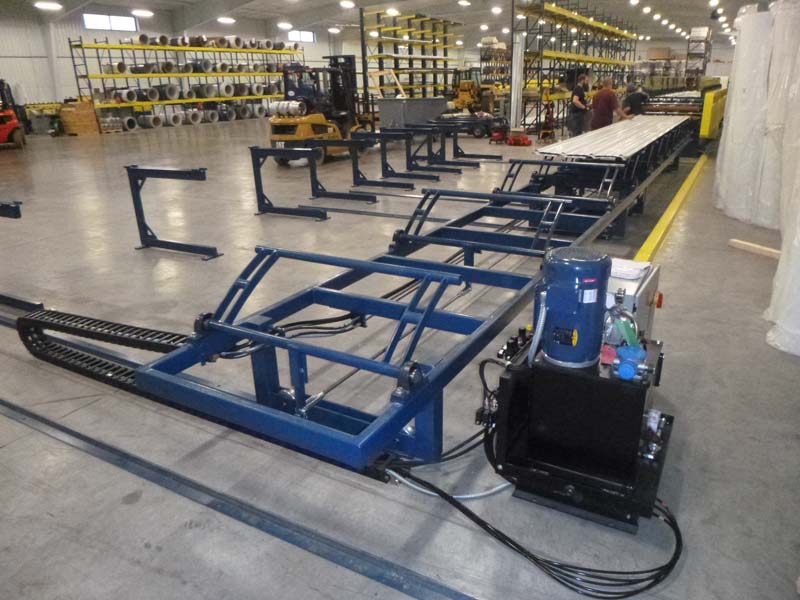
As production volume increases, power tables and conveyors become more attractive. Conveyor tables can move panels from the roll former to bundling, wrapping, or secondary operations with minimal manual intervention.
Most systems rely on powered rollers, often covered with protective materials to prevent scratching. However, sometimes rubberized rollers cause friction, so some prefer painted rollers. Gravity-only conveyors are less common for finished panels, as pushing long, heavy material by hand can be difficult and inconsistent. If the panels are going through a wrapping machine, powered rollers work better than manual movement.
Long conveyor runs—sometimes 80 feet or more—allow shops to run full orders before stopping the machine. Panels can be collected, bundled mechanically, and staged for wrapping or pickup, reducing stop-and-start inefficiencies.
Any rotating components on conveyors should include proper guarding, and safety markings, such as painted edges or safety tape, are commonly used to define pedestrian zones around moving equipment.
Coil Racks
Coil storage is more standardized than panel storage, but it still requires careful planning. Many coil racks are around 12 feet tall and 24 feet long and may hold approximately 20 coils. Shelves can be V-shaped or fitted with angled steel to prevent coils from rolling. Others leave racks without fitted holders, making it easy to store various size coils on one rack.
Heavy-duty coil racks may be rated at 50 tons or more, with individual shelves designed to support up to 30,000 pounds. Best practice is to store full coils on the bottom levels and partial coils higher up. Many shops also use coil pallets or coil carts when switching colors, allowing one coil to be staged while another is being loaded onto the decoiler.
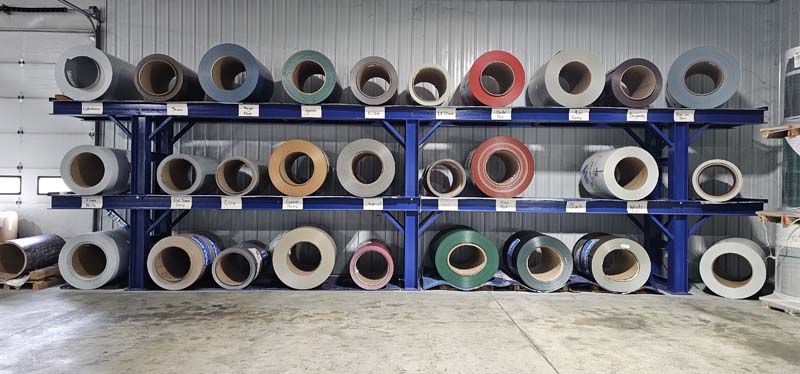
Knowing the maximum outside diameter and weight of coils before ordering racking is critical. Even small differences can determine whether coils fit safely on a shelf. Some shops use custom-built racking to fit their materials. Others prefer systems designed around common coil dimensions. Whichever you choose, make sure the racking works for your needs.
Because coil racks are usually serviced by forklifts, aisle width, visibility, and forklift paths must be considered early in the layout process. Blocking forklift traffic or creating blind corners can quickly become a safety and efficiency issue.
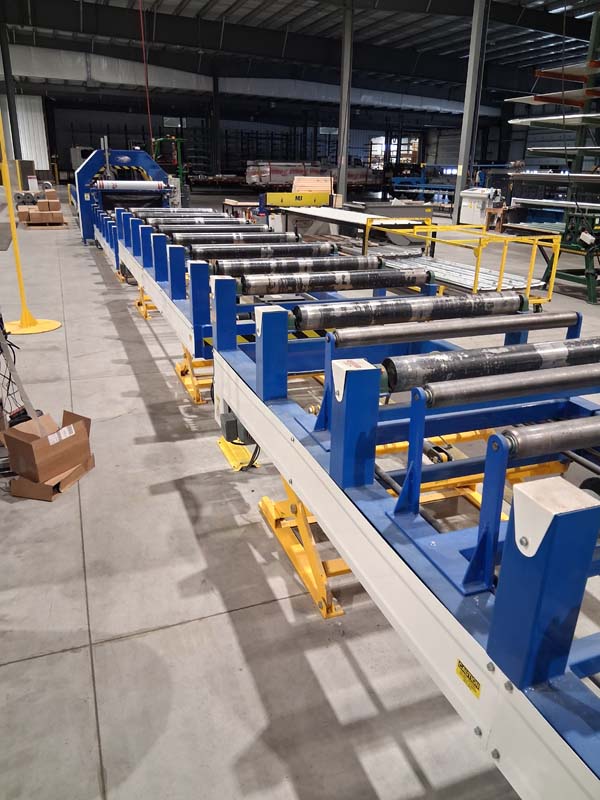
Photo Courtesy of Heartland Sales and Machine, LLC
Panel and Trim Racks
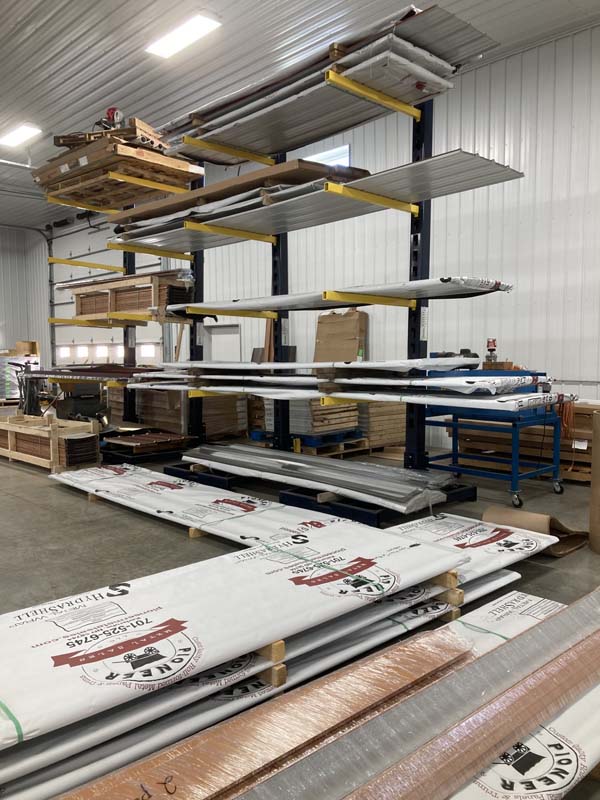
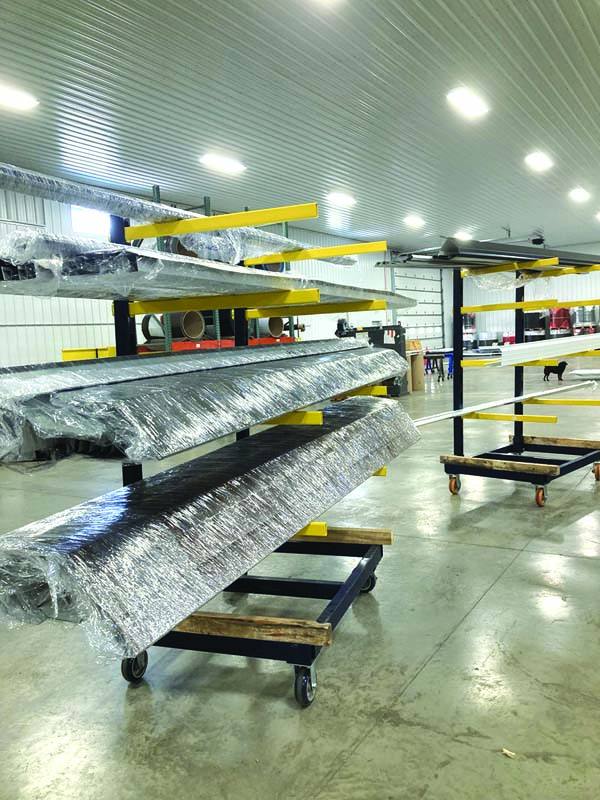
Once panels come off the roll former, storage needs change. Cantilever racking is a common solution for long panels, offering open access and high capacity. Double-sided cantilever racks allow shops to store twice the material in the same footprint, often providing better return on floor space.
Panel length drives rack design. Many shops store 8-, 10-, 12-, 14-, and 16-foot panels, sometimes with different profiles on each side of a double-sided rack. For example, one side might hold ag panels while the other stores board-and-batten profiles. Smaller profiles and shorter lengths are often staged on carts and moved closer to secondary operations.
Vertical cantilever racks are gaining traction in space-constrained shops. By storing material vertically, rollformers can significantly reduce the footprint required for finished panels, keeping floor space open for production.
Trim presents its own challenges. Flat stock may be palletized and stored in pallet racking or drawer-style systems, often organized by color. Some shops store trim flats on 20-foot pallets, four feet wide, stacked tightly to conserve space, and accessed with forklifts. Others use tray-style racks made for crane handling.
For panels longer than 20 feet, forklift mast height and panel deflection become concerns. Spreaders or expanding forklift attachments are commonly used to prevent bowing or damage during handling.
Carts and Modular Racking
Mobile carts have become a versatile alternative to fixed tables and racks. Adjustable-arm carts can be configured to carry panels, trim, or mixed profiles, and their ability to move through the shop makes them especially useful in evolving layouts.
Some carts feature adjustable arms that can be repositioned vertically in seconds using simple pins rather than bolts. This makes it practical to change arm height as bundle sizes or profiles change—something operators are more likely to do when adjustments don’t interrupt production.
Capacity varies by design, but some carts can carry up to 4,000 pounds while remaining movable by two people, particularly when used for lighter trim, gutters, or shorter panels. Multi-shelf configurations—often six to eight shelves—allow carts to replace tables entirely, holding several times more material in the same footprint.
Modular racking systems also allow shops to adapt pallet racking into cantilever-style storage, combining pallet storage for fasteners or accessories with panel storage in a single structure. Roof and side panels can even be added to some rack systems, creating sheltered storage without the cost of another building.
Layout, Safety, and Maintenance Considerations
Regardless of the accessories used, layout matters. Some shops intentionally design flow so raw material enters at one end of the building and finished product exits near the pickup area. Keeping coils near the roll former, flat stock near trim lines, and clear forklift paths throughout the shop helps avoid congestion.
Safety considerations are straightforward but critical. Racks should never be loaded beyond their rated capacity, and weight limits should be clearly marked. Uprights and arms must be assembled exactly as specified, with all bolts installed and tightened. Floor-mounted racks should be anchor-bolted to prevent tipping if struck by a forklift—especially in shops with new or inexperienced operators.
Maintenance requirements are generally low. Racking systems should be inspected periodically for damage, loose anchors, or signs of overloading such as twisted arms. Powder-coated finishes are often used for outdoor storage, and well-maintained racks can remain in service for decades. Power tables typically require routine greasing and occasional gearbox checks, while rollers benefit from keeping debris under control to protect finished surfaces.
Designing for Flexibility
No universal layout works for every roll-forming shop. Product mix, order size, space, building constraints, and staffing all influence accessory choices. What experienced roll formers agree on is the value of intentional design. Accessories that support flow, reduce handling, and adapt as operations change can extend the capacity of an existing roll former far more effectively than most expect.
In some cases, improving how material moves through the shop is the fastest path to higher output.
Resources
- Four Star Welding, 406-880-0323
- D.A. Hochstetler & Sons, www.plainmerchant.com/merchant/da-hochstetler/
- Star 1 Products, 231-825-0163
- Acu-Form Equipment, https://www.acuformequipment.com
- Heartland Sales & Machine, 574-223-6931
- Metal Rollforming Systems, https://mrsrollform.com